a sense of space
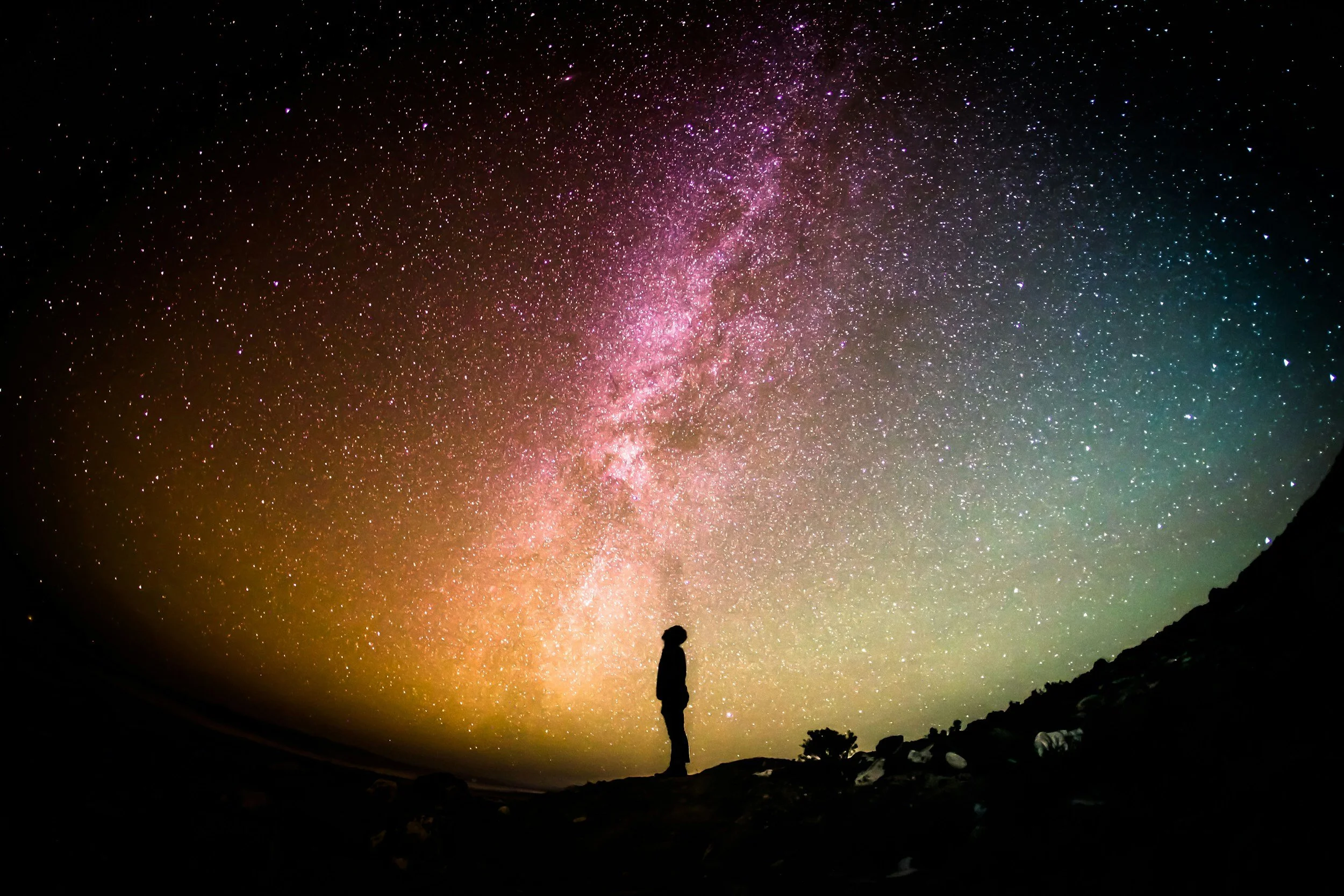
One night, on a recent camping trip, my tent pitched near a slow moving river, I looked up between the tops of lanky cedars and saw a red star. Unsure if it was a planet, unsure if it was signs of distant life in the universe, I did what all modern humans do the moment my phone had a signal, and I googled it. The stinging glow in the summer sky that had captured my sight was Antares.
I am but one of the eight billion people on the planet right now who may have seen that star, that very night. And we, all eight billion of us, are the descendants of more billions of people from over millions of years of human existence who may have also seen that star. To consider hundreds of billions of humans across evolution, looking up at that sparkle of red… I was moved.
Weeks later, I started reading a novel, Atmosphere, by Taylor Jenkins Reid. I found resonance right away, regarding my thinking about all the humans who’ve ever star-gazed. Early in the book, the protagonist’s childhood interest in Antares is described, as well as the anthropological and astronomical history of that particular hint of crimson in the dark. Over three quadrillion miles away, we here on Earth are just receiving its light. So when I was looking up between the silhouettes of trees, and catching the glow of Antares, I was seeing starlight that dates back 550 years. That light, on that one night, was 550 years old. And counting.
The astronomer in the novel is compelled by the shared history of that starlight— among all humans, all earthly creatures. The shared witnessing of time. But I am no astronomer. I don’t spend my days bearing witness to the cosmos. I never took an astronomy class, nor a physics class, nor a math class much harder than 8th grade algebra. (Lucky for my “alternative” spirit, I went to “alternative” schools.) No, I am no astronomer. Rather, I spend my days in witness of humanness. Humanness– made of stardust, sure, but also of love, and yearning, and uncertainty, and connection, and suffering.
And I’ve begun to wonder.
What if, when suffering wrenches our souls, fills our minds with murk, weighs down our bones... What if the experience is being transmitted from three quadrillion miles away? Doesn’t that give it some serious space? Think of it: maybe what we perceive to be our human experience of suffering comes from somewhere. Somewhere we can’t even imagine. In the same way we can’t even imagine from how long and far away a “binary red supergiant” in the sky is sending its vermillion luster to where we can see it, to when we can feel moved by it.
Maybe we don’t know how this part of the universe works. The idea of a “lightyear” is only 188 years old. The telescope was invented 418 years ago. Humans only really started tracking the stars in the last ice age, some 30,000 years back, give or take. To claim that we understand the universe is hubris. So maybe I’m onto something here. That the suffering we experience, as humans who are in no way separate from this infinite universe, is of the universe. Transmitted from a source unknown, a time inconceivable.
Perhaps then, there’s infinitely more expanse around the ache in our chests, more air around the choking in our throats, more openness surrounding a breaking heart, more possibility in loneliness…
And time, too– more time than we can grasp.
Antares itself is only estimated to be about 15 million years old. That’s nothing when you think of it.
So maybe the next time it all feels so constricting, so roiling, so suffocating, so inescapable, we should go outside. We should go wherever it’s night enough to look up and see the stars, the infinity above and past us. To soften our suffering. To give it to the sky. To trust from where it’s given.
To see what a sense of space does.
To remind us we know nothing. And nothing is final. And nothing is only one thing. To remind us of everything.
And maybe next time I’m on a camping trip, by a gentle river, in a clearing in the forest, from where humans have gazed at the sky since time immemorial,
I’ll remember.